This edition of the Annual Report you are reading is full of meaning.
First of all, it is worth mentioning the 48th anniversary of Cepel's foundation. Over almost half a century, the vision of former minister Professor Antonio Dias Leite Júnior was consolidated. His role was fundamental in the Center's creation so that the Brazilian electricity sector could have a research and technology institution with technical and financial autonomy, with “efficiency and objectivity characteristics arising from the entrepreneurial spirit.”
The realization of this vision owes much to Dr. Jerzy Zbigniew Leopold Lepecki, who directed the Center between 1974 and 1991, leaving the valuable legacy that is the trust that the institution enjoys in the energy market, in fact, due to the proactive action of its founding members and main sponsors, the Eletrobras companies.
Since its early years, the Center was designed to be an institution of high technical capacity, with the main objective of providing the country with an important laboratory infrastructure in the electrical energy area, to be, in short, the expression of the innovative proposal that it brings since its genesis. Yes, Cepel was born when the installed capacity in the Brazilian electrical system was only 10% of last year's (2021)1.
Since its inception and throughout these nearly five decades of existence, the Center's mission has always been to become a reference for the national electricity sector and to develop technological solutions to increase reliability and efficiency in energy supply to Brazilians.
But the past and the current years have brought (and still bring) other elements that are as inspiring and challenging as the years of the Center's creation and consolidation. The completion of Eletrobras' capitalization process, which will have been completed when this report is published, is one of them.
This is of great significance because it marks a necessary evolution in the relationship between Cepel and its founding associates, in the sense of making it, shall we say, more adult. Contrary to some's speech, Cepel should not distance itself from the Eletrobras companies. The relationship between the institutions, however, must provide elements that will not only reaffirm the interest of these companies in research, development, and innovation but will also expand it, on a professional basis and with a desired market driven. Furthermore, it will open up ample space for the evolution and reaffirmation of the Center as a high-tech institution in Brazil and in the world.
To face the gigantic challenge imposed on Cepel' preservation, the year 2021 was crucial. Several initiatives were put into practice, starting with carrying out the strategic planning, with the prestigious support of FGV Energia.
Decomposed into four dimensions, the strategic planning mapped nine strategic objectives, namely:
Learning and growth dimension
- excellence in human resources management;
- adequacy of human capital;
- technological update of the infrastructure;
Internal processes dimension (innovation and efficiency)
- excellence in knowledge development;
- focus on the market;
- excellence in cost and revenue management;
Market and stakeholders dimension (institutional and market relations)
- expansion of representation and membership strengthening;
- conquest of new markets;
Financial dimension
- financial autonomy.
Since the end of the year 2021, strategic projects are being defined and actions and initiatives implemented in the direction indicated by the strategic planning. Those actions and initiatives will be intensified throughout 2022.
To fulfill these purposes, renewal, commitment, efficiency, and dedication are required. In the last three years, the advisory functions to the board have been significantly reduced. Today, the entire management support staff, including administrative support and, department managers2 , corresponds to only seven percent (7%) of the Center's entire workforce. In the same period, there was a 70% renewal in the management of these departments, indicating a healthy renewal in the Center's management.
Along the same lines, efforts have been made to establish strategic partnerships to strengthen and expand the Center's activities. Examples are the MoU signed with Google Cloud at the end of 2021, which brings the expectation of accelerating products and solutions developed by Cepel, and the advancement of understandings with the Italian CESI towards improving the laboratories' management.
In line with the transformations imposed by the energy transition, it is worth noting the inauguration of the Smart Grids Laboratory, at the Adrianópolis Unit, the result of a partnership with the Ministry of Mines and Energy, Petrobras and Eletrobras itself, and the planning of pioneer projects aiming at research focused on green hydrogen (H2V), in partnerships with Vale and SPIC Brasil, always with the support of Eletrobras and its companies.
Concerning improving governance, 17 corporate policies were identified to be submitted to Cepel's Deliberative Council. Four of them were revised in 2021: the Code of Ethics and Integrity, the Personal Data Protection and Privacy Policy, the Conflict-of-Interest Management Policies, and the Information Security Policy. Four others had their review started: the Consequences Policy, the Supply Logistics Policy, the People Management Policy and the Occupational Health and Safety Policy.
Among the internal initiatives, we highlight the organizational restructuring implemented at the end of 2021, streamlining the advisory and management functions, the preparation of the first PDTI - Information Technology Master Plan, which allowed for the improvement of IT governance at Cepel by ordering, consolidating and streamlining initiatives in the area, generating, in 2021 alone, savings of around R$ 765 thousand in avoided costs, and the implementation of the Technical Project Management Office (EGP-T), allowing the organization and rationalization of monitoring and the prioritization of activities aimed at better meeting the technical commitments assumed by the Center. Also noteworthy is the publication, last year, of the first fully digital Administration report produced based on the directives of the Global Reporting Initiative (GRI), a successful experience that is repeated with this report.
Other important measures associated with strategic planning that are already underway are the review of the Center's Bylaws, towards modernizing the governance model and adjusting it to the reality that will arise from the Eletrobras capitalization process, the review of the bidding and contracting, to provide greater agility to the goods and services acquisition processes, and the structuring of a business and innovation area, to expand the Center's commercial and negotiating capacity.
And this was all done while facing the Covid-19 pandemic, which remained on the scene last year, despite advances in vaccination. Cepel established a careful plan to return to face-to-face activities as of the mid-year, focusing mainly on laboratory activities which, by their very nature, are not completely suited to the telework regime. The return to face-to-face activities of the entire Center effectively took place in December 2021, when vaccination against Covid-19 in the country had already advanced considerably. Nevertheless, understandings were initiated with the staff and with the union entities to an agreement that would establish the bases for the adoption of the teleworking regime in the Center, where applicable, of course.
The year 2021 was therefore a year of important achievements. Despite the difficulties and mishaps, the increase of more than 19% in revenue from the sale of products and services is worthy of note, which in 2021 exceeded BRL 36 million, corresponding to 17.3% of all inflows3 (in 2020 this proportion was 13.3%).
Such results must be credited mainly to the Center's employee team, whether researchers and administrative support or outsourced collaborators. Justice must recognize and value the greatest asset of an institution that mainly produces knowledge, which is its staff. The Management's most sincere and respectful thanks are due to all Cepel employees. We extend this gratitude to the Center's associates, partners, and customers.
Have a good read!

Consuelo Garcia
(Corporate Management Director)
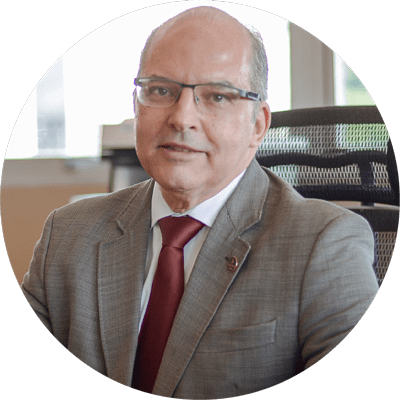
Amilcar Guerreiro
(General Director)

Maurício Barreto Lisboa
(Technology Director)
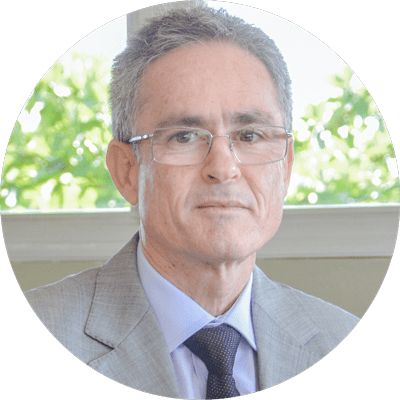
Orsino Borges de Oliveira Filho
(Director of Laboratories and Technological Services)
1. According to the National Energy Balance, published by the Energy Research Company (EPE), the installed capacity in 1974, the year Cepel was founded, was 18,133 MW. Last year, this matrix diversified and had an installed capacity of 181,160 MW. According to the National Energy Balance, edited by the Energy Research Company (EPE), the installed capacity in 1974, the year Cepel was founded, was 18,133 MW. Last year, this matrix diversified and had an installed capacity of 181,160 MW. 2. Overall, the new organizational structure implemented at the end of 2021 has 16 administrative units. 3. Before the financial result.